
Top Secret KGB Lecture on U.S. Intelligence Community
From the original handwritten class notes of a junior KGB officer

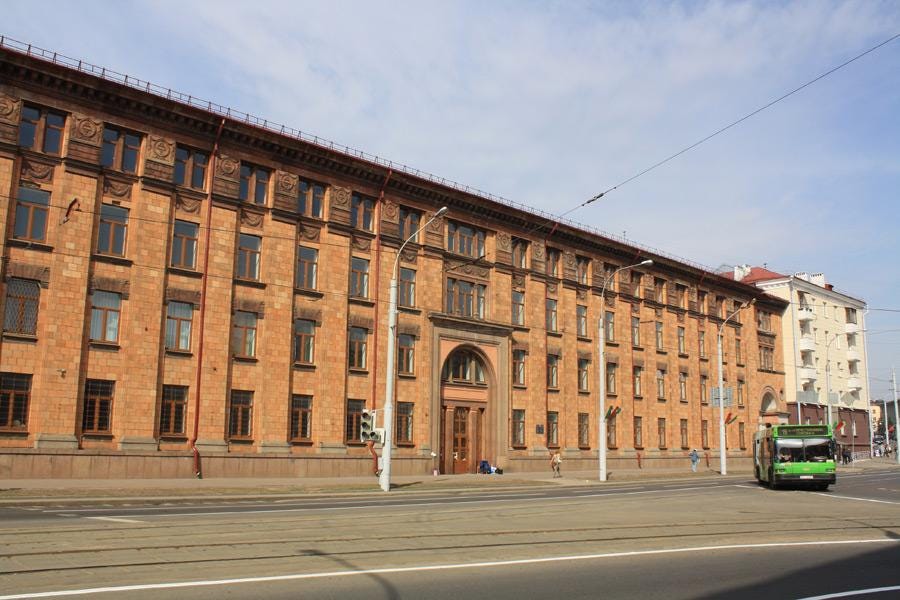
Perestroika and glasnost were well underway in the Soviet Union when E. Jonušas, a young KGB officer from Lithuania, entered the Higher Courses of the KGB in Minsk in early September 1987. The Higher Courses, one of the top KGB counterintelligence training institutions, was located in central Minsk in two large buildings on Zmytrak Byaduli Street.1 Today the same buildings house the Institute for National Security of the Republic of Belarus where Belarus state security officers are trained to preserve, protect, and defend the current regime.
Jonušas’s training lasted a full year, and he took a variety of specialized courses which the KGB called “special disciplines.” After he completed the training and returned to Vilnius, he deposited four notebooks with his class notes in the archive of the Lithuanian KGB where they were classified top secret.
Following the collapse of the Soviet Union and the establishment of an independent Lithuania, these documents were transferred to the Lithuanian Special Archives (LYA). While researching the LYA document collections, I located the notebooks and have spent several months deciphering Jonušas’s almost illegible handwriting.
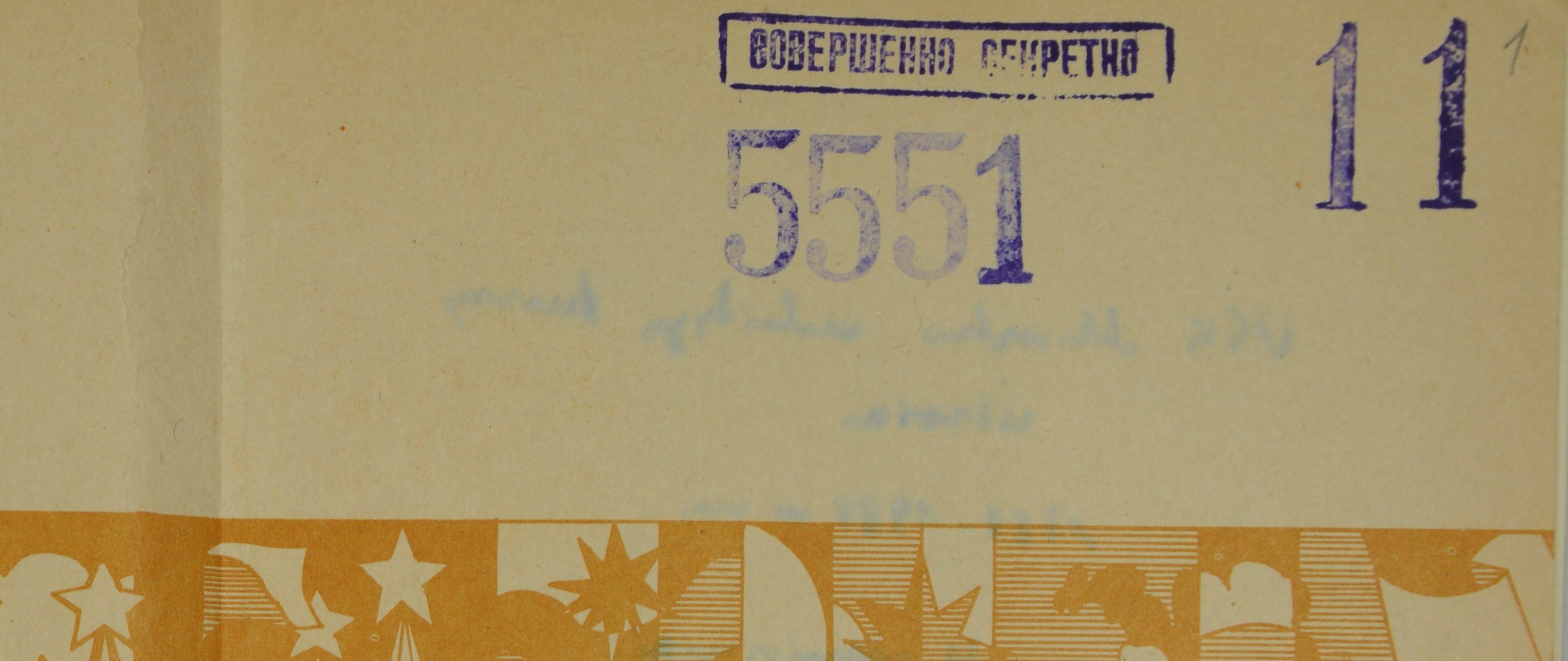
Among many lectures, which I discuss in detail in a paper I am writing for an academic conference, one of the most interesting ones was a lecture on the U.S. intelligence community.2 This lecture offers a remarkable “fly-on-the-wall” perspective into how the KGB portrayed the CIA and other U.S. intelligence agencies in a classified setting. Little did the KGB know that one day somebody will gain access to their top secret lectures.
The “Main Adversary”
The lecture on the U.S. intelligence community was included in the “special discipline No. 6” (SD-6) whose main focus was on what the KGB defined as the subversive activities of foreign intelligence services. It took place on March 31, 1988, and was delivered by Colonel V. Sharov, who was the head of a department at the Higher Courses.
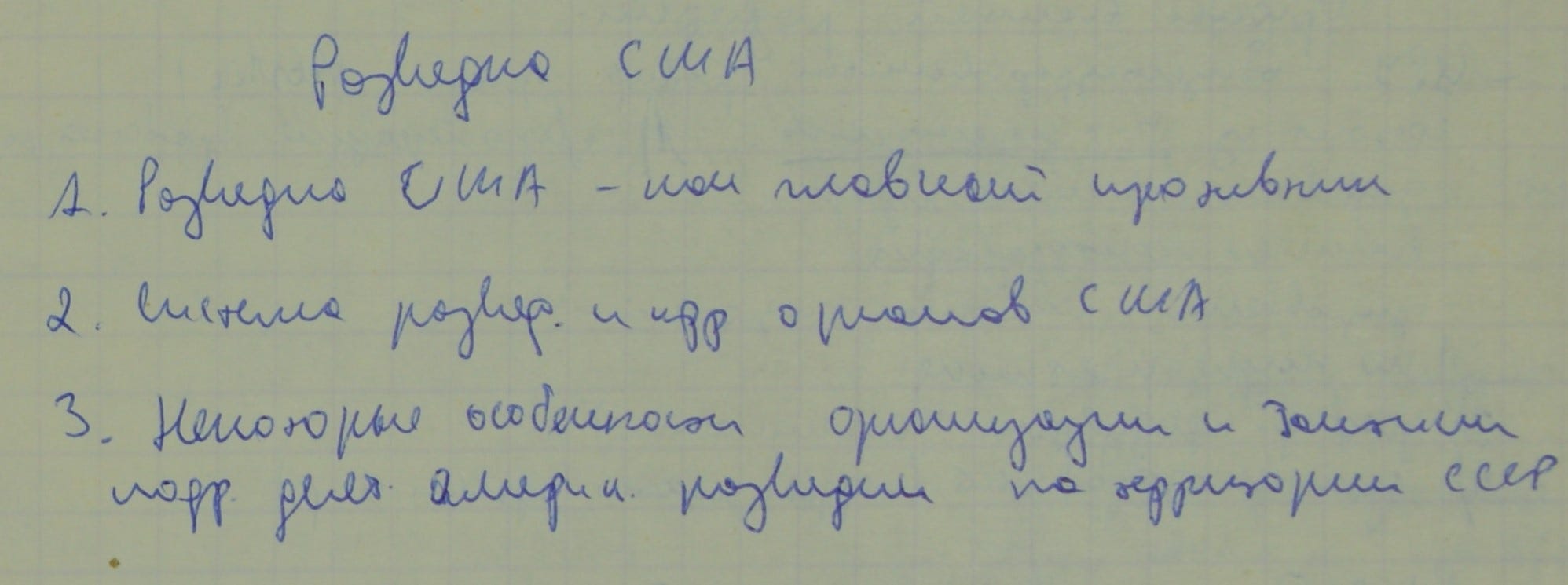
Sharov did not mince words. Right away, he referred to the U.S. as “our main adversary” and claimed that 70 percent of the U.S. intelligence resources were directed against the Soviet Union. He also said that 80 percent of all recruitment attempts targeting Soviet citizens in the 1970s were carried out by the U.S. intelligence agencies. He must have awed the cadets by describing the vast U.S. global surveillance network which he claimed consisted of about 4,000 radio intercept positions, including the locations in the People’s Republic of China.
Sharov introduced the cadets to the complex structure of the U.S. intelligence community, which, he said, consisted of 20 different intelligence and counterintelligence services.3 He told them that the U.S. president had the ultimate decision-making authority regarding intelligence matters but that there was also the National Security Council (NSC) composed of the other top officials in the administration.
Perhaps because the CIA always loomed large for the KGB counterintelligence, Sharov also claimed that the director of the CIA was a permanent member of the NSC. This, however, was not accurate. While the CIA director is typically present at the meetings of the NSC, he is not a statutory member and has only a non-voting, advisory role.
Sharov had more things to say about the CIA, presenting that which the KGB believed was true, not necessarily what was actually true. He claimed for instance that the CIA’s annual budget was $18 billion (equivalent to about $50 billion today) and that the CIA employed 200,000 people globally. However, this global coverage apparently also had gaps and challenges. According to Sharov, the CIA was “weaker” in Asia and Africa than in other parts of the world.4
Sharov shared with the cadets the organizational structure of the CIA which he said was composed of four Directorates: Operations, Science & Technology, Production [Analysis], and Administration/Support. He seemed to have had a particular fascination with the Directorate of Operations, which, he claimed, employed 40 percent of the CIA workforce and was sub-divided into the Directorates for Foreign Intelligence, Foreign Counterintelligence, and Covert Operations. As you can see in the scan below, Sharov correctly identified [William] Webster as the director of the CIA at that time.
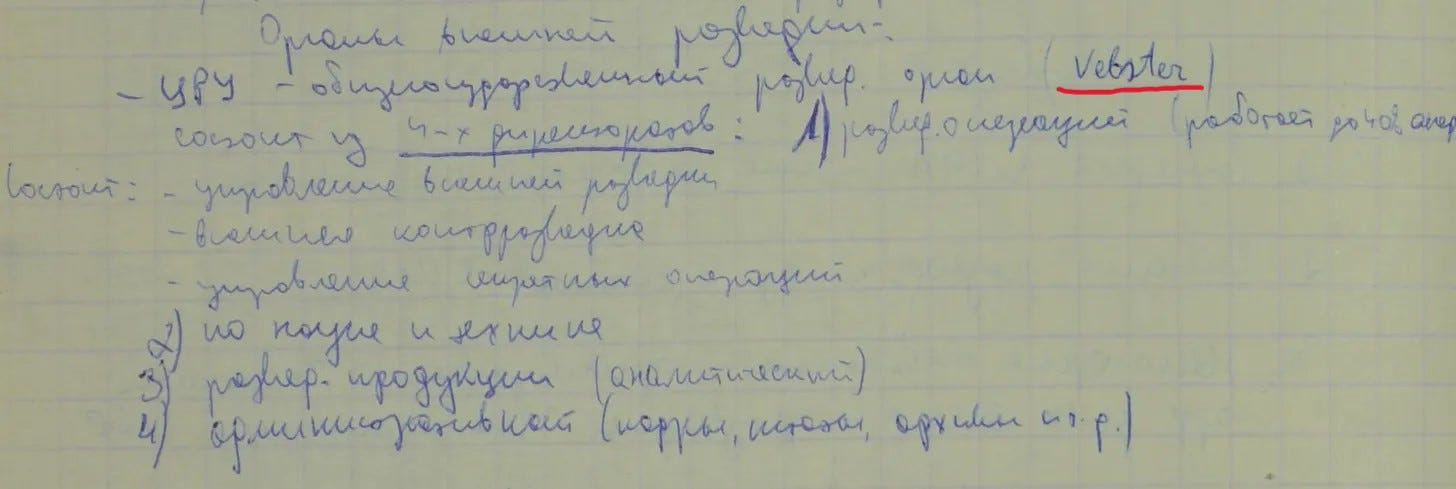
The next on Sharov’s list of U.S. intelligence agencies was the National Security Agency (NSA) which, according to Sharov, was tasked with the collection of “radio-electronic” intelligence, the decryption of the codes and ciphers of other countries, and the development and protection of the U.S. ciphers and communication channels.5
The NSA was followed by the Defense Intelligence Agency (DIA) described as the main intelligence branch of the Ministry [Department] of Defense. Sharov noted that each service of the U.S. Armed Forces also had its own intelligence division: Army, Navy, Air Force, and Marine Corps. Sharov did not mention Coast Guard and there was no Space Force in the late 1980s.
According to Sharov, in addition to the Department of Defense, there were other Ministries [Departments] in the U.S. government that had their own intelligence units. He listed only the Departments of State, Energy, Commerce, and Agriculture, which is not the complete list.6 Surprisingly, he skipped the Department of Justice and said absolutely nothing about the FBI. It looks like the KGB counterintelligence officers were not interested in talking about their U.S. counterparts. Perhaps they did not care (or dare) to look at themselves in comparative perspective.
Seminar Discussion: What’s Going to be on the Test?
Lectures at the Higher Courses were typically followed by class discussions of the topics under consideration. This lecture was no exception. Jonušas noted that during the seminar discussion, they talked about the specifics of the U.S. intelligence “sabotage activities” in the Soviet Union. For instance, they discussed how the U.S. intelligence officers collected information and recruited agents.7 The methods of recruitment allegedly ranged from the ideological and moral-psychological arguments to the provision of material benefits. There was no talk of coercion or compromise.
Another topic of discussion was how the U.S. intelligence officers tried to act as the agents of influence in Soviet society and sway Soviet public opinion and even some Soviet decision-makers in the direction favorable to the U.S. strategic goals. They were said to covertly support those perceived as the critics of the Soviet system, the “dissidents,” and destabilize the Soviet system from the inside.
At the end of the seminar, the cadets were given several questions which they needed to work on to prepare for the test. Most of the questions were straightforward and dealt with U.S. intelligence recruitment activities, use of special equipment, and general strengths and weaknesses. One, however, was remarkable in its theoretical depth: “American intelligence is often called the ‘invisible government’ of the United States. Is such a statement justified? Explain.”8

There is nothing in Jonušas’s notes that hints at how he might have answered this question. Perhaps it was just too hard for him, and he skipped it on the exam.
Interestingly, Sharov’s lecture also did not include the phrase “invisible government,” which was the title of the 1964 bestseller by the journalists David Wise and Thomas B. Ross centered on the activities of the CIA.9 But the phrase must have been mentioned in one of the course textbooks which still remain classified.
It’s worth pondering what the KGB would have considered as an ideal answer.
The former director of the Federal Security Service (FSB) and long-time Secretary of the Security Council, Nikolai Patrushev, “the second most powerful man in Russia,” is a graduate of the Higher Courses of the KGB in Minsk in the 1970s. So was the recently deceased former Russian Minister of Defense, Sergei Ivanov.
“Aukšųjų kursų (Minskas) klausytojo E. Jonušo mokymosi užrašai [Class Notes of the Higher Courses (Minsk) Cadet E. Jonušas],” Lietuvos Ypatingasis Archyvas (LYA) [Lithuanian Special Archives], F. K-40, Inv. 2, File 7, p. 63.
“Class Notes,” F. K-40, Inv. 2, File 7, p. 64.
“Class Notes,” F. K-40, Inv. 2, File 7, p. 63.
“Class Notes,” F. K-40, Inv. 2, File 7, p. 64.
Ibid.
“Class Notes,” F. K-40, Inv. 2, File 7, p. 66.
“Class Notes,” F. K-40, Inv. 2, File 7, p. 65.
David Wise and Thomas B. Ross. The Invisible Government. New York: Random House, 1964.
Amazing work, as always, best Filip🙏🙏🙏
In that the USIC (in general) prefers to recruit their agents from certain US colleges, do the Russians do likewise? Is the University of Kazan one of these favored institutions of higher learning?